How to convert old blog posts from HTML to Markdown for AI training?
Most companies already have more AI training material than they realise.
Years of blog posts, guides, resource hubs, help docs, landing pages, and archived thought leadership often represent the best domain knowledge a business owns. The problem is not a lack of content. The problem is the format.
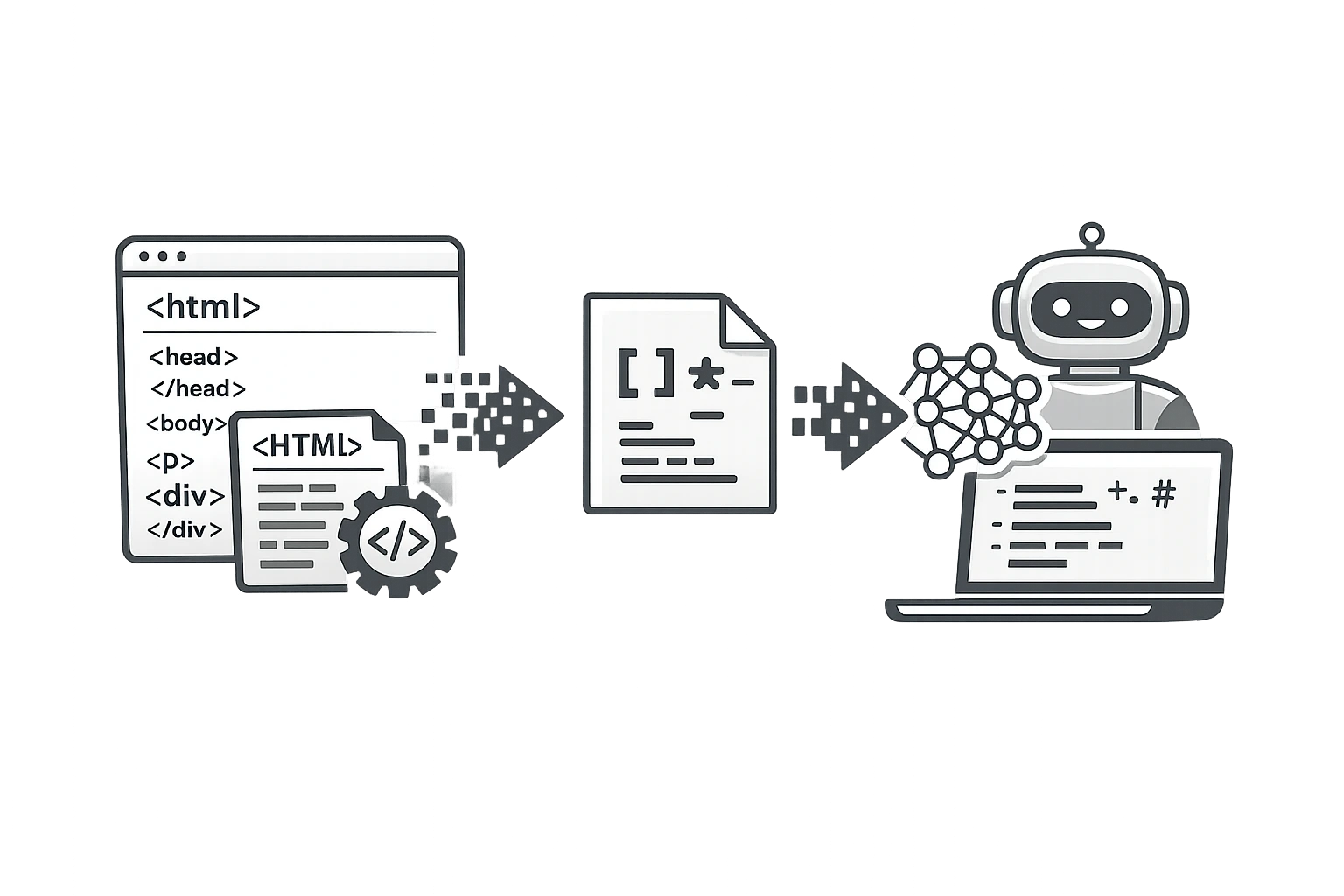
Legacy content is usually trapped in bloated HTML. It contains navigation fragments, inline styles, unrelated footer links, tracking scripts, widget wrappers, old embeds, promotional clutter, and structural inconsistencies from past CMS migrations. That may be acceptable for browser rendering. It is not ideal for AI training.
This is where an HTML-to-markdown AI workflow becomes valuable.
Markdown is not magic, and it is not the only acceptable format for large language model workflows. Some retrieval systems deliberately preserve HTML, and research such as HtmlRAG suggests that raw HTML can outperform plain text for certain retrieval tasks. But for many practical AI content operations use cases, especially chunking, summarisation, fine-tuning preparation, editorial review, and lightweight retrieval corpora, Markdown offers a cleaner and more manageable representation of the content itself.
That is why more teams are asking how to convert HTML to Markdown that LLM pipelines can actually use.
If you want to prepare legacy blog archives for internal AI search, assistant grounding, knowledge base creation, or training data preparation, this guide walks through the right process: audit, clean, normalise, convert, validate, and protect privacy.
Why do many LLM workflows prefer Markdown over raw HTML?
The key advantage of Markdown is signal clarity.
Markdown reduces boilerplate noise
HTML pages often include:
- navigation menus
- button wrappers
- div-heavy layout containers
- inline CSS
- scripts
- tracking pixels
- unrelated footer content
- cookie banners
- share widgets
An LLM can process HTML, but much of that content is not useful for understanding an article's substance. Markdown removes much of the surrounding noise and preserves the meaningful structure:
- headings
- paragraphs
- lists
- tables
- links
- blockquotes
That makes downstream processing easier.
Markdown is easier to chunk and version
For AI training and retrieval workflows, content teams often need to:
- split content into sections
- compare versions
- store files in repositories
- tag source documents
- transform content into embeddings or prompt-ready chunks
Markdown handles these tasks cleanly because it remains human-readable and structurally obvious.
Markdown often improves editorial review
AI teams are not the only stakeholders. Legal, brand, SEO, and content ops teams may need to review the dataset before it is used. Markdown is far easier for non-developers to inspect than messy raw HTML.
A nuanced point: HTML still has value in some AI systems
It is important not to oversimplify. Some AI and retrieval workflows benefit from preserving HTML structure, DOM relationships, or layout-aware parsing. The point is not that HTML is unusable. The point is that for many practical AI training data preparation tasks, Markdown offers a better balance of readability, portability, and reduced noise.
Cisco’s Webex developer blog has argued that converting content to Markdown can significantly improve LLM performance and accuracy across many use cases. That aligns with what many content and ML teams observe operationally: cleaner inputs usually produce cleaner outputs.
HTML clutter vs. Markdown clarity for AI training
| Content characteristic | Raw legacy HTML | Clean Markdown |
|---|---|---|
| Readability for human review | Low | High |
| Boilerplate noise | High | Low |
| Ease of chunking | Moderate to poor | High |
| Version control friendliness | Low | High |
| Portability across systems | Moderate | High |
| Suitability for editorial cleanup | Poor | Strong |
| Risk of irrelevant page chrome entering the dataset | High | Lower |
Why do legacy blog archives need preparation before AI use?
Dumping old pages into an LLM pipeline is a data quality mistake.
Poor data quality is expensive
Gartner has long estimated that poor data quality costs organisations at least $12.9 million annually. That figure is broader than AI alone, but it is highly relevant here. Bad inputs create bad outputs, wasted time, unreliable retrieval, and harder governance.
IBM has also warned that poor-quality data compounds risk as companies increase their dependence on AI. In its data quality insights, IBM notes that weak training data makes inaccurate or irrelevant model behaviour more likely.
For marketing and content teams, that means:
- Outdated product claims get surfaced
- brand voice becomes inconsistent
- deprecated pricing or features leak into outputs
- Legal or compliance issues resurface
- hallucinations become harder to detect because the source set is messy
A five-stage workflow to prepare old HTML blog posts for AI training
A reliable HTML-to-markdown AI process is not just a conversion step. It is a pipeline.
Stage 1: Audit the legacy content library
Start by identifying what should and should not enter the dataset.
Create inclusion rules
Separate content into:
- evergreen knowledge
- historical but still useful perspective pieces
- outdated content needing revision
- content that should be excluded entirely
Exclude assets such as:
- obsolete product announcements
- event recap pages with no lasting value
- thin content
- duplicate pages
- low-quality syndicated material
- pages containing sensitive customer or partner information
This step is essential. Conversion does not fix poor source selection.
Stage 2: Clean the HTML before conversion
If you convert raw page source without cleanup, the Markdown output may still carry junk.
Remove non-content elements
Strip out:
- Headers and navigation
- Footers
- Sidebars
- Cookie notices
- Related post widgets
- Ad modules
- Pop-ups
- Form wrappers
- Tracking and analytics scripts
Preserve only meaningful structure
Keep:
- title
- subtitle if relevant
- body text
- headings
- lists
- tables
- important links
- image alt text or captions if useful
- publication metadata if needed
The goal is to extract the article, not the webpage chrome.
Stage 3: Normalise before or after conversion
Legacy blogs often contain years of inconsistency.
Normalize:
- heading hierarchy
- punctuation style
- link formatting
- author attribution
- dates
- callout formatting
- table structure
- code blocks or quotes where relevant
If 500 blog posts use five different heading patterns, your AI dataset becomes less consistent and harder to chunk correctly.
Stage 4: Convert HTML to Markdown
Once content is cleaned, convert it into Markdown using a structured tool rather than manual copy-paste. The CampaignMorph HTML/Markdown Converter is well suited for this type of workflow because it gives content teams a straightforward way to transform older HTML content into a cleaner format that is easier to review, reuse, and prepare for AI pipelines.
At this stage, check that:
- headings map correctly
- lists remain intact
- Tables survive where needed
- links are preserved sensibly
- extraneous styling is removed
- line breaks are not distorted
Stage 5: Validate the output for AI use
Do not assume the converted file is ready.
Run quality checks
Review for:
- broken heading hierarchy
- duplicated navigation text
- leftover CTA clutter
- malformed tables
- missing paragraphs
- outdated product references
- internal jargon that needs annotation
Then test the content in the actual downstream use case:
- retrieval
- summarization
- assistant grounding
- fine-tuning set preparation
- internal search
Privacy and security during conversion
This is the most neglected part of AI training data preparation.
Sensitive content can hide in old pages
Legacy HTML can contain:
- Internal comments accidentally exposed in the source
- personal data from testimonials or case studies
- partner names under NDA
- old email addresses or phone numbers
- tracking parameters
- hidden form fields
- unpublished fragments left by earlier templates
Before conversion, define privacy rules.
Use a privacy-first review checklist
Ask:
- Does the page contain personally identifiable information?
- Does it mention confidential customers or campaigns?
- Is there outdated legal language?
- Are tracking codes or tokens embedded in links?
- Is any user-generated content present?
- Are there hidden page fragments that should be excluded?
Treat conversion as data handling, not just formatting
If the archive includes sensitive information, process it in a controlled environment. Keep logs of what was included, what was excluded, and why. That matters for governance and future auditing.
Building an AI-ready content library after conversion
Once posts are converted to Markdown, organise them intentionally.
Recommended metadata fields:
- title
- original URL
- publication date
- last reviewed date
- content category
- product relevance
- audience type
- approval status
- privacy classification
This turns a pile of old blog content into a reusable knowledge asset.
Common mistakes teams make when converting HTML to Markdown for AI
Avoid these traps:
- converting everything without auditing relevance
- Keeping promotional clutter inside the dataset
- ignoring outdated content
- failing to normalise titles and headings
- overlooking privacy review
- not validating converted output in the actual AI workflow
- assuming Markdown alone solves data quality
Markdown is a format improvement. Governance is the real advantage.
Where does CampaignMorph fit?
For marketing ops, content ops, and AI teams trying to modernise legacy content, the CampaignMorph HTML/Markdown Converter helps simplify one of the most painful steps in the pipeline: getting old blog content out of heavy HTML and into a cleaner, reviewable format.
That does not replace auditing or governance. It makes them easier.
Cleaner content libraries produce better AI outcomes
AI systems do not become useful because you feed them more content. They become useful because you feed them better content.
If your organisation has years of HTML blog archives, start treating them as a knowledge asset that warrants proper preparation. Audit what matters, remove what does not, protect privacy, convert with care, and validate the output against your actual use case.
A disciplined HTML-to-markdown AI workflow gives your team a cleaner foundation for retrieval, training, and content intelligence. If you are starting the cleanup process, the CampaignMorph HTML/Markdown Converter is a practical way to migrate legacy content to a more AI-ready format.
Choose a small batch of legacy posts, audit them for relevance and privacy, convert them to Markdown, and build the first version of a cleaner, safer AI-ready content library.
Share this article
Help other marketers, developers, and creators discover these insights.