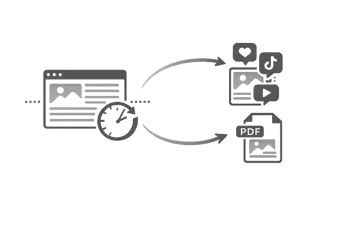
How AI Detection Works for Content & Images? A Complete Technical Guide

How Does AI Detection Work for Content and Images?
The internet is producing AI-generated content at a scale that would have seemed implausible five years ago. Text written by language models, images synthesised by diffusion networks, and voices cloned from audio snippets now circulate alongside human-created material across search results, social feeds, newsrooms, and academic platforms.
This shift has triggered a parallel arms race: developing tools and standards that can identify machine-generated content, verify image provenance, and flag deepfakes before they cause harm. But how AI detection works is widely misunderstood. The term describes at least four distinct technical approaches that operate on different principles, have different accuracy rates, and suit different use cases.
This guide breaks down each approach, explains the research behind it, and covers real-world accuracy, limitations, and the regulatory context shaping detection in 2026.
Why Does AI Detection Matter Now?
The scale of synthetic content has changed the stakes
AI-generated content is no longer a curiosity. Large language models (LLMs) like GPT-4, Claude, and Gemini can produce fluent, coherent text on almost any subject at near-zero marginal cost. Generative image models such as Midjourney, DALL-E, Adobe Firefly, and Stable Diffusion create photorealistic imagery from text prompts in seconds.
This has practical consequences across several industries:
- Education: Academic institutions must distinguish student work from AI-assisted submissions.
- Journalism: Newsrooms must verify whether images and reports are authentic or synthetically created.
- Marketing and advertising: Brand safety teams need to understand whether AI-generated assets comply with disclosure requirements.
- Legal and compliance: Regulatory frameworks in the EU and elsewhere now mandate disclosure and labelling of AI-generated content.
The regulatory context: EU AI Act Article 50
The EU AI Act's transparency obligations under Article 50 became applicable on August 2, 2026 1. These requirements cover:
- Systems that generate synthetic audio, image, video, or text must mark the output in a machine-readable format so it can be detected as artificially generated or manipulated.
- Deployers of deepfake-producing AI must disclose that the content is artificially generated.
- Systems interacting directly with people (chatbots, virtual assistants) must inform users they are dealing with an AI.
A grace period for legacy systems applies to the machine-readable marking obligation until December 2, 2026 1. For marketers, publishers, and content teams working across the EU, understanding the technical mechanisms behind AI detection is no longer optional; it is a compliance question.
Part 1: How AI Text Detection Works
1.1 Perplexity and burstiness: the early statistical approach
The first generation of AI text detectors, which emerged in 2022 and 2023, relied primarily on two statistical signals: perplexity and burstiness 2.
Perplexity measures how "surprised" a language model is by a given sequence of words. When an LLM generates text, it is optimised to predict the most probable next token. As a result, its outputs tend to display low perplexity; they are statistically predictable relative to the model's own training distribution 3. Human writing, by contrast, tends to make less predictable word choices, producing higher perplexity scores.
Burstiness measures the variation in sentence structure and length throughout a document 4. Human writing is typically characterised by high burstiness: authors naturally shift between short declarative sentences and longer, complex constructions. AI-generated text often exhibits lower burstiness and a steadier, more uniform rhythm that many detectors learn to recognise.
These signals formed the backbone of early classifiers used in tools like GPTZero, which launched in December 2022 and was among the first publicly available AI text detectors.
However, perplexity and burstiness have significant limitations:
Research published in 2024 and 2025 has shown that these metrics frequently fail when applied to formal academic writing, legal prose, or writing produced by non-native English speakers — all of which can exhibit low perplexity and burstiness without being machine-generated 5. They are also increasingly bypassed by newer LLM architectures, particularly diffusion-based language models (such as LLaDA), which can mimic human patterns more effectively than earlier autoregressive models. 2.
Most researchers and developers now view perplexity and burstiness as incomplete and outdated when used in isolation. 2.
1.2 Neural classifier models
More sophisticated text detectors train neural networks directly on large labelled datasets of human-written and AI-generated text. These classifiers analyse probability curvature, syntactic patterns, and distributional features that go beyond simple perplexity or sentence-length metrics.
Tools like Originality.ai and Copyleaks use variants of this approach, often fine-tuning transformer-based models to extract features specific to particular LLMs.
Classifier-based approaches are limited because their performance is tightly coupled to the models they were trained on. As new LLMs are released or fine-tuned, classifiers must be retrained to maintain accuracy.
1.3 Watermarking: the most reliable current method
Watermarking represents the most technically rigorous and reliable approach to AI text detection currently available, but it requires integration at the generation stage, which limits its scope.
How does LLM watermarking work?
Modern LLM watermarking, as implemented in Google DeepMind's SynthID-Text, does not add hidden characters or append metadata to text files. Instead, it operates during the token generation process by subtly biasing which words the model selects 6.
The mechanism works as follows:
- A secret key and the preceding context divide the model's vocabulary into two groups: "favoured" (green) tokens and "disfavoured" (red) tokens.
- During generation, the model is nudged, not forced, to prefer green-list tokens slightly. This nudge is small enough that it does not meaningfully degrade the readability or quality of the output.
- A detector that knows the secret rule can run a statistical hypothesis test on a passage to determine whether the frequency of green-list tokens is significantly higher than chance. If it is, the content is flagged as watermarked. 6.
This approach is implemented in Google DeepMind's SynthID-Text, which uses a pseudo-random "g-function" and a logits processor applied to the model's generation pipeline. Google has open-sourced this technology through the Responsible GenAI Toolkit and Hugging Face Transformers (v4.46.0+), allowing other developers to incorporate it into their own models. 7.
Limitations of watermarking
The watermark signal is tied to the specific token sequence generated. If a user heavily paraphrases, rewrites, or translates the AI-generated text, the statistical pattern is often disrupted, and the watermark becomes undetectable. 6.
Watermarking also faces an adversarial risk: studies have shown that the token-selection nudge can occasionally influence model behaviour in subtle ways, such as affecting tool-calling accuracy or refusal patterns. 6.
Critically, the absence of a watermark does not confirm human authorship. It may simply mean the content was generated by a model that does not implement watermarking. 7.
1.4 Commercial AI detector accuracy and false positive rates
Academic and independent evaluations have raised serious concerns about the reliability of commercial text detection tools, particularly their false positive rates (the rate at which human-written text is incorrectly flagged as AI-generated) 5.
Key findings from research conducted in 2024 and 2026:
- False positive rates for native English speakers typically range from 1% to 20% depending on the tool and the study methodology 5.
- Non-native English (ESL) speakers are disproportionately flagged. Studies have documented false positive rates as high as 61% for TOEFL and ESL essays because these tools interpret grammatically structured, simplified, or formal language as likely machine-generated 5.
- Formal academic writing, which follows predictable standardised patterns, is also frequently misidentified. 5.
| Detector | Reported False Positive Rate (General) | Notes |
|---|---|---|
| GPTZero | ~3% – 9% | Higher for short text and ESL writing 5 |
| Turnitin | ~1% – 4% | Varies by document vs sentence level 5 |
| Originality.ai | ~1% – 2% | 5 |
Note: Accuracy rates vary significantly by study methodology, text length, and whether the subject is a native English speaker.
Because of these reliability concerns, a growing number of universities, reportedly over 25 major institutions, have restricted or turned off AI detection tools for disciplinary action5. Both the detection companies and most academic guidance emphasise that detector scores should be treated as indicators requiring human review, not as standalone evidence of misconduct. 5.
Part 2: How AI Image Detection Works
AI image detection is a distinct technical challenge from text detection. It spans several overlapping approaches: forensic pixel analysis, frequency domain analysis, neural classifiers, and provenance-based standards.
2.1 Forensic pixel and spatial analysis
GAN-generated images (from Generative Adversarial Networks) and diffusion-model images often contain subtle visual artefacts invisible to the human eye but detectable by trained models.
Early detectors primarily used Convolutional Neural Networks (CNNs) to identify spatial inconsistencies: irregular blending at boundaries, unnaturally smooth skin textures, facial landmark misalignments, and lighting or shadow inconsistencies 8. These features reflect how generative models construct images from latent representations rather than through physics-based rendering.
Transformer-based architectures are increasingly used alongside CNNs because they generalise better across different types of AI generators. 8.
2.2 Frequency domain analysis
GAN-based image generation often leaves specific signatures in the frequency domain of an image, patterns that become visible when an image is transformed using tools such as the Discrete Cosine Transform (DCT) or the Fast Fourier Transform (FFT) 9.
These artefacts arise from the upsampling operations used in GAN architectures, which introduce grid-like patterns into frequency representations. Early frequency-based detectors achieved high accuracy on specific datasets but often overfit, performing well on images from one GAN model yet failing on images from another. 9.
Recent research frameworks, including FreqNet and FreqBlender (published at AAAI and NeurIPS, respectively), focus on "source-agnostic" feature learning: training detectors that can generalise to unseen generative models by learning frequency features shared across architectures rather than specific to one. 9.
2.3 Hybrid spatial and frequency approaches
State-of-the-art deepfake detection in 2024 and 2025 combines spatial and frequency analysis into unified frameworks. For example, Phase-Amplitude Frequency Enhancement modules extract spectral signatures and feed them into attention-based networks alongside spatial CNN features. 9.
Accuracy statistics on real-world data:
- Specialised models report training and testing accuracies of 88% – 93% on controlled academic benchmark datasets 9.
- The Deepfake-Eval-2024 benchmark revealed a significant real-world performance gap: state-of-the-art models saw an AUC drop of 45%–50% when tested against contemporary, real-world deepfakes compared with legacy datasets. 9.
- Human detection accuracy for deepfakes remains near chance levels, approximately 58% – 60% overall, meaning even imperfect automated detectors consistently outperform humans in large-scale screening.g 9.
2.4 The SynthID approach for images
Google DeepMind's SynthID also includes an image watermarking component. When a supported AI model generates an image, it integrates the watermark at the pixel level rather than storing it as separate metadata. Because the signal is part of the image data itself, it is designed to persist even if the image is resized, edited, or re-saved 7.
A detector trained on the specific signal can analyse an image to determine the probability that a model equipped with SynthID generated it. Like the text version, the image watermark is imperceptible to the human eye. 7.
SynthID is not a universal solution: it only marks content produced by AI models that have been configured to use it. The absence of a SynthID mark does not mean an image is human-made.e 7.
2.5 Metadata and EXIF analysis
Many AI image generators embed provenance data into an image's XMP or EXIF metadata fields, including information about the generator (such as DALL-E, Adobe Firefly, or Google Gemini) or specific "DigitalSourceType" ta.gs. 10.
Limitations of metadata-based detection:
Most major social media platforms, including Instagram, Facebook, and X (Twitter), automatically strip EXIF and XMP metadata when images are uploaded, destroying provenance signals at the point of social distribution 10. Metadata can also be manually deleted or edited, making it a weak signal that should support but not replace other detection methods. 10.
Part 3: The C2PA Standard: Provenance Over Detection
One of the most significant developments in AI content identification is a shift in approach: rather than trying to detect AI-generated content retroactively, the Coalition for Content Provenance and Authenticity (C2PA) provides an infrastructure to verify content history before and during distribution.
How C2PA works
C2PA embeds a cryptographically signed manifest called Content Credentials into media files, including images, videos, audio, and documents 11. This manifest acts as a tamper-evident record of the content's lifecycle.
The manifest records:
- Who created the content and with what tools
- When and how it was generated or modified
- Whether AI was used at any stage in production
- If a file was built from other assets ("ingredients"), those are listed, creating a traceable chain back to the source
Because the manifest is cryptographically signed, if anyone alters any part of the file after the signature is applied, verification fails and alerts the viewer that the provenance is broken. 11.
Importantly, C2PA does not declare content "true" or "false." It provides verifiable transparency: it can confirm that a specific camera model took a photograph, or that Adobe Firefly or OpenAI's DALL-E generated an image.
C2PA adoption and ecosystem
C2PA was founded in 2021 by Adobe, Microsoft, Intel, Arm, the BBC, and Truepic. The coalition has since expanded to include Google, Meta, OpenAI, Sony, Amazon, and TikTok. 11.
Hardware adoption is accelerating. Camera manufacturers, including Leica, Nikon, and Samsung (with the Galaxy S25 series), have implemented native C2PA support to capture credentials at the point of creation 11. Cloudflare became the first major content delivery network to support C2PA, helping preserve provenance data across the web. 11.
Social platforms including Meta (Facebook, Instagram, Threads) use C2PA signals as inputs for their automated AI content labelling systems. 10.
What C2PA cannot do
Most social media platforms strip metadata when users upload content. If an image with valid C2PA credentials is uploaded to Instagram or X, the credentials are often removed, breaking the provenance chain at that point 10. C2PA is most effective in contexts where the file is distributed with its metadata intact: professional media workflows, news wire services, and platforms that have committed to preserving credentials.
Part 4: Platform-Level AI Labelling
Major platforms have developed their own AI content labelling systems that operate independently of, but increasingly alongside, standards like C2PA.
Meta (Facebook, Instagram, Threads): Meta employs a two-pronged approach 10:
- Automatic detection using industry-standard signals, including C2PA credentials, to apply "AI Info" or "Made with AI" labels
- Self-disclosure requirements, where users are asked to label AI-generated or AI-modified content during upload
YouTube: Creators must disclose "realistic altered or synthetic content", including AI-cloned voices and AI-manipulated visuals of events or people. This policy was introduced in 2024 and is enforced through 2025–2026 10.
X (Twitter), TikTok, Google Search: All have introduced or are developing systems to surface AI origin labels, using a combination of C2PA signals, pixel-level analysis, and voluntary disclosure 10.
Part 5: The Core Limitations Across All Methods
Across both text and image detection, researchers and practitioners are candid about the constraints of current approaches.
It is a cat-and-mouse problem.
As generative models improve, detectors must keep pace. The Deepfake-Eval-2024 benchmark results show a 45–50% AUC drop against real-world deepfakes, underscoring how quickly generative content can outpace purpose-built detectors. 9.
Metadata stripping breaks the provenance chain.s
C2PA credentials, currently the most robust method for image provenance, are routinely stripped when content moves through social media platforms 10. This is one of the primary challenges for the standard's real-world utility.
False positives carry real costs.
Incorrectly classifying human writing as AI-generated can have serious consequences: academic discipline, editorial rejection, and damage to professional reputation. Research consistently shows these false positives disproportionately affect non-native English writers and people with formal or structured writing styles. 5.
Absence of a signal is not proof of human origin.
No watermark does not mean human-made. No C2PA credential does not mean untampered. Every detection method tells you something, but none tells you everything. Robust evaluation requires layering multiple signals and applying human judgment.
Summary: Which Detection Method Does What?
| Method | Best For | Limitation |
|---|---|---|
| Perplexity / Burstiness | General stylistic screening | High false positive rate; easily bypassed |
| Neural classifiers | Detecting specific known LLM outputs | Requires retraining as models evolve |
| LLM Watermarking (SynthID) | Reliable detection for supported models | Cannot detect unmarked content; breaks under heavy rewriting |
| Pixel / Spatial forensics | Image deepfake screening | Real-world accuracy drops significantly vs lab benchmarks |
| Frequency analysis | GAN artefact detection | Overfits to specific generators |
| C2PA provenance | Establishing verified origin history | Stripped by most social platforms |
| Platform labeling | Consumer-facing disclosure | Dependent on platform policies and upload integrity |
Frequently Asked Questions
What does "AI detection" actually mean?
AI detection refers to any technical method used to identify whether content text, images, audio, or video was generated or significantly modified by an artificial intelligence system. It includes statistical analysis, machine learning classifiers, cryptographic watermarking, and provenance tracking, each using different principles.
Can AI text detectors be trusted?
Partially. Commercial text detectors have meaningful false positive rates; they sometimes flag human-written content as AI-generated. Research shows false positive rates ranging from 1% to 61% depending on the tool, the content, and the author's native language. Use them as indicators to prompt further review, not as definitive evidence of misconduct.
What is C2PA and why does it matter?
C2PA (Coalition for Content Provenance and Authenticity) is an open technical standard that embeds cryptographically signed metadata called Content Credentials into media files. It records the content's creation and editing history in a tamper-evident way. It matters because it shifts verification from retroactive detection to proactive provenance: it records whether AI was used at creation, rather than trying to guess after the fact.
Does deleting EXIF metadata remove AI labels?
It removes metadata-based signals, but not pixel-level watermarks like SynthID or provenance chains recorded before the file was exported. C2PA credentials embedded before upload may survive if the receiving platform preserves them, but most social platforms currently strip metadata on upload.
Is AI image detection reliable?
For controlled laboratory conditions, some detectors achieve 88–93% accuracy. In real-world conditions, performance drops significantly. The Deepfake-Eval-2024 benchmark found AUC drops of 45–50% when detectors were tested against contemporary real-world synthetic images. Detection is improving but remains an active research challenge.
Citations
Footnotes
- European Union. EU AI Act, Article 50 — Transparency Obligations for Certain AI Systems. Transparency provisions applicable from August 2, 2026; machine-readable marking grace period for legacy systems until December 2, 2026. artificialintelligenceact.eu ↩ ↩2
- arXiv preprint research on diffusion-based LLMs and detection limitations (2025–2026). Published findings on how newer LLM architectures (e.g., LLaDA) cause high false-negative rates in traditional perplexity/burstiness detectors. arxiv.org ↩ ↩2 ↩3
- Metric37; Pangram Labs. Published statistical analyses of perplexity as a signal for AI-generated text and its limitations when applied to formal writing. ↩
- GPTZero. Documentation on the burstiness metric and its application to AI text detection. gptzero.me ↩
- Multiple independent academic studies (2024–2026) on false positive rates in commercial AI text detectors. Includes HEPI (UK Higher Education Policy Institute), ResearchGate meta-analyses, and independent testing of GPTZero and Turnitin. Key findings: ESL false positive rates documented as high as 61%; over 25 universities have restricted automated detector use for disciplinary decisions. hepi.ac.uk ↩ ↩2 ↩3 ↩4 ↩5 ↩6 ↩7 ↩8 ↩9 ↩10 ↩11
- Google DeepMind. SynthID-Text: Watermarking LLM text outputs. Technical description of the g-function, green/red token partitioning, logits processor, and hypothesis-testing detection mechanism. Open-sourced via Hugging Face Transformers v4.46.0+. Also includes research findings on adversarial limitations (paraphrasing, token nudge side effects). deepmind.google ↩ ↩2 ↩3 ↩4
- Google DeepMind. SynthID: Identifying AI-generated content in images and text. Technical overview of pixel-level image watermarking and scope limitations. Explicitly states: absence of a SynthID mark does not confirm human authorship. deepmind.google/technologies/synthid ↩ ↩2 ↩3 ↩4 ↩5
- Engineering in Technology and Applied Science Research (ETASR). Deepfake detection using CNN and transformer-based architectures — a 2024 published review of detection approaches for AI-generated images. ↩ ↩2
- Multiple 2024 academic publications on deepfake image detection: FreqNet (AAAI 2024), FreqBlender (NeurIPS 2024), Deepfake-Eval-2024 benchmark (arXiv). Key findings: 88–93% lab accuracy; 45–50% AUC drop in real-world evaluation; human baseline detection approximately 58–60%. ↩ ↩2 ↩3 ↩4 ↩5 ↩6 ↩7 ↩8
- PixelPeeper; ExifReader; Lumethic; Kinesso UK. Reporting on EXIF and XMP metadata stripping by social platforms, and AI labelling practices by Meta, YouTube, TikTok, and others (2024–2026). pixelpeeper.com; exifreader.com ↩ ↩2 ↩3 ↩4 ↩5 ↩6 ↩7 ↩8 ↩9
- C2PA (Coalition for Content Provenance and Authenticity). C2PA Specification and Content Credentials framework. Founded by Adobe, Microsoft, Intel, Arm, BBC, and Truepic; expanded to include Google, Meta, OpenAI, Sony, Amazon, and TikTok. Hardware adoption includes Leica, Nikon, and Samsung Galaxy S25; CDN adoption by Cloudflare. c2pa.org ↩ ↩2 ↩3 ↩4 ↩5
Share this article
Help other marketers, developers, and creators discover these insights.