WebP vs AVIF : Which Image Format Should You Use?
The High Stakes of Image Optimisation in 2026
As web performance standards tighten and user expectations soar, image optimisation remains one of the most critical levers for technical SEO. Images routinely account for over 50% of an average webpage's total byte weight. For SEO professionals, developers, and website owners, serving the right image format is no longer a minor technical detail; it is directly tied to Core Web Vitals, specifically Largest Contentful Paint (LCP). Google heavily emphasises fast-loading visuals, explicitly recommending that webmasters serve images in next-gen formats.
For years, WebP has been the undisputed king of next-gen formats, offering substantial savings over legacy JPEG and PNG files. However, the rapid emergence of AVIF has triggered a major debate in the web performance community. When evaluating WebP vs AVIF in 2026, which format truly reigns supreme? This comprehensive guide breaks down the history, technical merits, and practical SEO implications of both formats, helping you make the optimal choice for your digital infrastructure.
What is WebP?
Developed by Google and released in 2010, WebP was engineered specifically for the web as a replacement for both JPEG and PNG. It employs predictive coding (borrowed from the VP8 video codec) to encode images, offering both lossy and lossless compression.
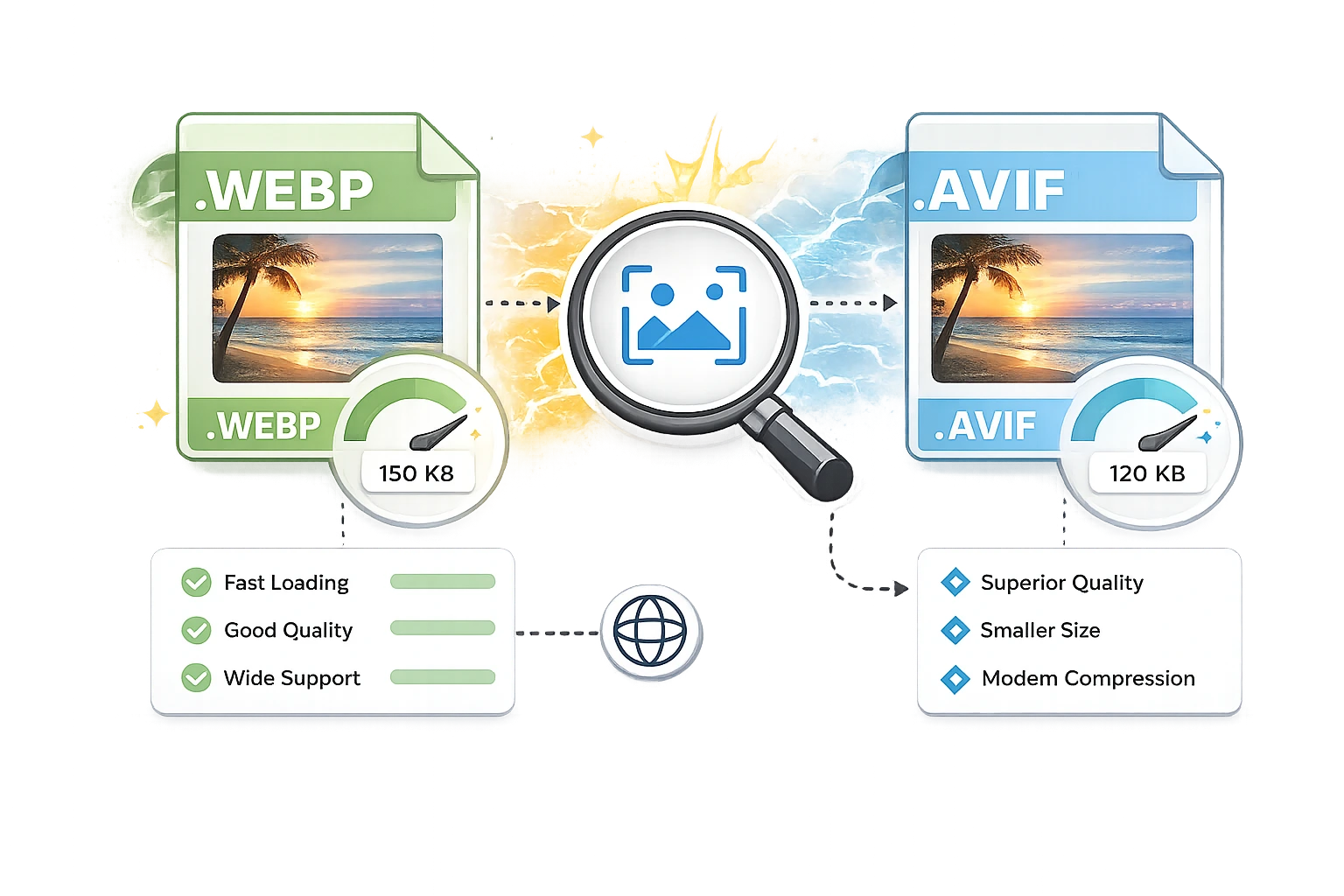
- Pros: WebP files are generally 25-34% smaller than comparable JPEGs and 26% smaller than PNGs. Crucially, it supports both animation (unlike standard JPEGs) and transparency (unlike standard JPEGs). Because it is a Google creation that has been part of the ecosystem for over a decade, it is deeply integrated with almost all content management systems (CMS) and Content Delivery Networks (CDNs).
- Cons: While highly efficient, WebP's compression ceiling has been surpassed by newer codecs. At extremely low bitrates, WebP can introduce noticeable colour banding and blurring compared to modern alternatives.
- Browser Support: As of 2026, WebP enjoys near-universal adoption. According to Can I Use data, WebP browser support sits comfortably at 95.67%, meaning practically every user on modern desktop and mobile browsers can view WebP natively.
What is AVIF?
AVIF (AV1 Image File Format) represents the bleeding edge of image compression technology. Developed by the Alliance for Open Media, a consortium that includes tech giants such as Google, Apple, Netflix, and Amazon, AVIF is based on the highly efficient AV1 video codec. It was standardised in 2019 and has seen a rapid uptake in browser support over recent years.
- Pros: AVIF offers unprecedented compression ratios. For similar visual quality, AVIF is typically 20-35% smaller than WebP. It supports high dynamic range (HDR), wide colour gamut, transparency, and animation. AVIF is uniquely capable of preserving crisp text and sharp edges within images, even at high compression levels.
- Cons: Encoding AVIF requires more computational resources and takes longer than WebP. Older, low-powered servers may struggle to generate AVIF images on the fly. Furthermore, while integration is improving, not all legacy CMS platforms support AVIF uploads out of the box without plugins.
- Browser Support: AVIF adoption has grown aggressively. Currently, AVIF browser support is approximately 93.8%. Safari, Chrome, and Firefox all support it, though users on severely outdated OS versions may still face compatibility hurdles.
Detailed WebP vs AVIF Comparison
To determine the best image format for SEO in 2026, we must evaluate both formats across several technical vectors.
| Feature | WebP | AVIF |
|---|---|---|
| File Size (Compression) | Excellent (25-34% smaller than JPEG) | Superior (20-35% smaller than WebP) |
| Image Quality at Low Bitrates | Good, but prone to blurring/banding | Exceptional, maintains sharp edges and HDR |
| Encoding/Decoding Speed | Very fast (low CPU overhead) | Slower encoding (requires more CPU) |
| Transparency (Alpha Channel) | Supported | Supported (handles edges better) |
| Animation Support | Supported (WebP Animated) | Supported (AVIFS) |
| Global Browser Support | 95.67% | ~93.8% |
Core Web Vitals and LCP Impact
Google's Core Web Vitals metric, Largest Contentful Paint (LCP), measures the time it takes for the largest visual element on the screen (often a hero image) to render. By reducing payload size, both WebP and AVIF directly accelerate LCP. Because AVIF is routinely smaller, serving a hero image in AVIF can shave crucial milliseconds off your LCP, making it the mathematically superior choice for strict performance optimisation.
Which Format Should You Choose for SEO in 2026?
The decision between WebP and AVIF depends on your technical capabilities and audience.
When to use WebP: If you rely on dynamic server-side image generation where CPU overhead is a concern, or if you are working within a legacy CMS environment that lacks AVIF support, WebP remains a phenomenally efficient and deeply reliable choice. Its 95.67% browser support guarantees your images will display correctly.
When to use AVIF: If maximum performance is your goal and your infrastructure (or CDN) supports it, AVIF is the clear winner for 2026. The 20-35% size reduction over WebP provides an undeniable edge in competitive SEO environments where every millisecond matters for rankings and user retention.
The Best Practice (Content Negotiation): In 2026, the ultimate SEO strategy is to serve both formats using the HTML <picture> element or via CDN content negotiation. By offering AVIF with a WebP fallback, you deliver the absolute lightest file to modern browsers (93.8% of users) while providing a highly optimised WebP to the remaining legacy users.
How to Convert Images Safely for Web Workflows?
Transitioning a website's image library to next-gen formats requires careful handling to ensure colour profiles and transparency layers are preserved. Bulk converting legacy JPEGs and PNGs should not result in quality degradation.
For a seamless workflow, use the CampaignMorph Image Compressor. Designed for marketers and developers, this tool converts high-resolution source files into highly optimised WebP and AVIF formats without compromising visual quality. It intelligently balances encoding speed with maximum compression, ensuring your assets are perfectly tuned for Core Web Vitals.
To see how WebP and AVIF conversion fits into an end-to-end production workflow alongside aspect ratio cropping, SVG dividers, and automated masking, read our comprehensive Frontend Web Asset Pipeline Guide.
As visual web standards evolve, staying ahead of image compression technology is mandatory for peak SEO performance. While WebP offers unparalleled reliability and excellent compression, AVIF has matured into the definitive champion of file size reduction and quality retention for 2026. By implementing a dual-format strategy using modern HTML or CDN-level negotiation, you secure the best of both worlds. Upgrade your visual assets today using the CampaignMorph Image Compressor and watch your LCP metrics plummet.
Share this article
Help other marketers, developers, and creators discover these insights.