The Complete Guide to Nonogram Puzzles: Rules, Strategies and Free Generator
What is a nonogram?
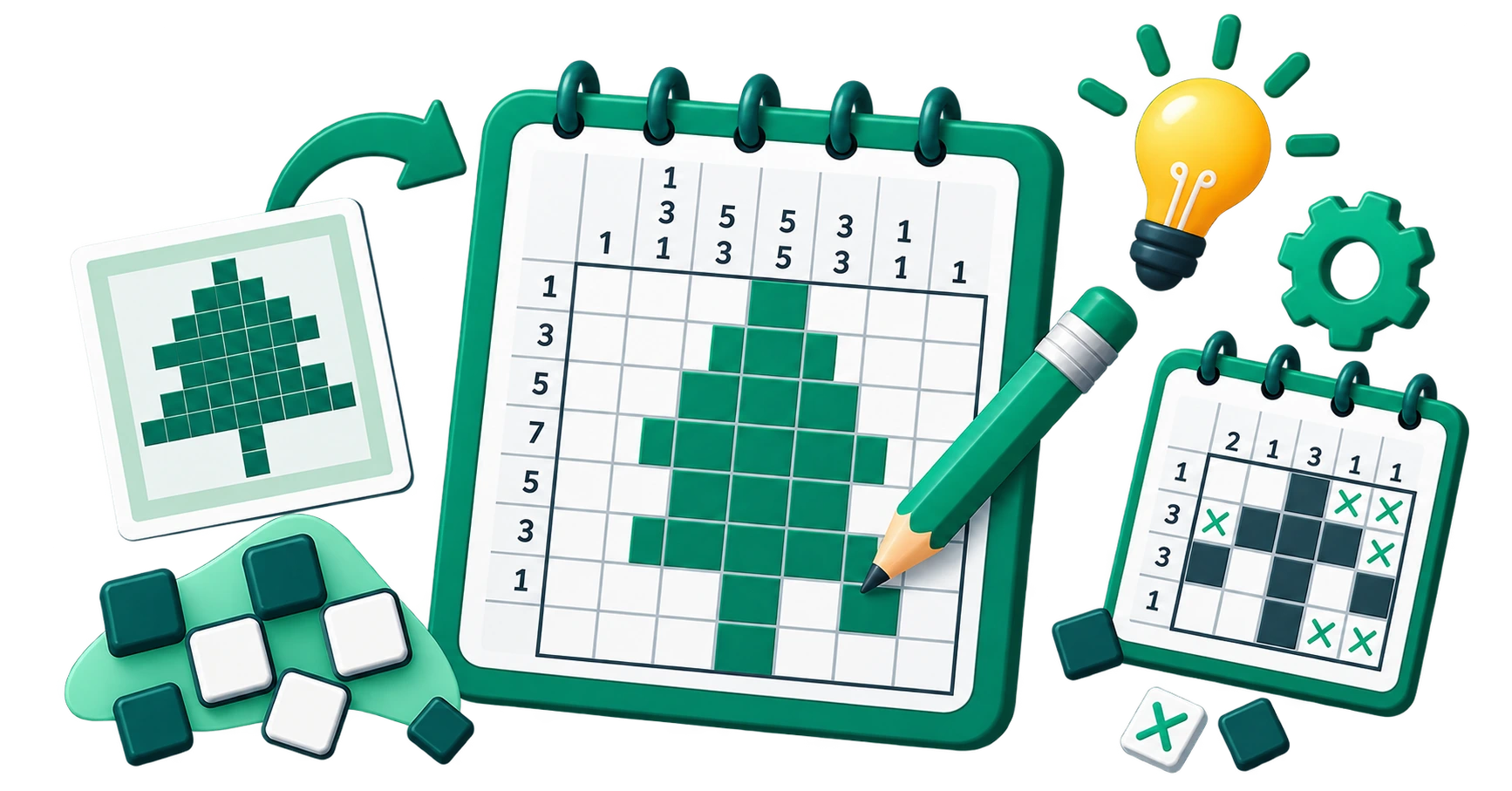
A nonogram is a logic puzzle that reveals a hidden picture inside a grid. Each row and each column of the grid carries a sequence of numbers called clues. These clues tell you how many consecutive cells in that line must be filled in, and in what order. When you fill in the correct cells and leave the rest empty, a black-and-white image appears.
The puzzle was independently invented in 1987 by two people: Non Ishida, a Japanese graphic editor, and Tetsuya Nishio, a Japanese puzzle designer. Ishida won a competition in Tokyo by designing a picture using a grid of skyscraper windows that could be either lit or unlit. This concept became the foundation of the nonogram as it is known today.
The many names of the same puzzle
Different publishers and platforms use different names for the same puzzle format:
| Name | Origin |
|---|---|
| Nonogram | Named after Non Ishida; the most common generic English term |
| Picross | Nintendo's trademark, used in their handheld game series since 1995 |
| Paint by Numbers | Used by The Sunday Telegraph (UK) when they syndicated the puzzle in 1990 |
| Griddlers | Trademark of Conceptis Puzzles, a commercial puzzle syndication company |
| Hanjie | Used in some UK puzzle magazines |
All five names describe the same rules and the same solving process. In this guide we use "nonogram" because it is the most widely recognised non-trademarked name.
The rules of nonogram puzzles
Cell states
Every cell in a nonogram grid has exactly two possible final states:
- Filled: the cell is part of the hidden picture. You mark it black (or any colour).
- Empty: the cell is not part of the picture. You leave it blank.
During solving, many players also use a third temporary state:
- Crossed out (×): you have logically determined this cell must be empty. Marking it helps you keep track as you work through the rest of the grid.
How to read the clues?
Each row and each column has its own list of clue numbers. A clue list like 3 1 2 means:
- A group of exactly 3 consecutive filled cells
- Followed by at least one empty cell
- Then a group of exactly 1 filled cell
- Followed by at least one empty cell
- Then a group of exactly 2 filled cells
The groups must appear in the order listed, from left to right (for rows) or top to bottom (for columns). There must be at least one empty cell between each group.
A clue of 0 means the entire line is empty. A clue that equals the full line length (for example, 10 on a 10-cell row) means every cell in that line is filled.
Grid sizes and difficulty
| Grid size | Total cells | Typical solve time | Best for |
|---|---|---|---|
| 5×5 | 25 | 1–3 minutes | Beginners, children |
| 10×10 | 100 | 5–15 minutes | Daily puzzles, mobile play |
| 15×15 | 225 | 15–30 minutes | Intermediate solvers |
| 20×20 | 400 | 30–60 minutes | Experienced solvers |
| 25×25 | 625 | 60–120 minutes | Hardcore puzzle enthusiasts, printable books |
Larger grids produce more detailed images but require significantly more steps in deduction.
Solving strategies: beginner to advanced
Nonograms are solved through pure deduction, not guessing. Here are five strategies, ordered from the most basic to the most advanced.
Strategy 1: The overlap method
This is the single most important technique for solving nonograms.
If a row has 10 columns and the clue is 7, the filled group can start at column 1 (filling columns 1–7) or as late as column 4 (filling columns 4–10). The overlap between these two extremes is columns 4–7, which must be filled regardless of where the group starts.
The general formula: if the clue value is greater than half the line length, there is a guaranteed overlap. This technique alone can immediately resolve a large portion of cells in most puzzles.
Strategy 2: Edge logic
If you know a cell at the very edge of a line must be filled (from column or row cross-referencing), you can extend the fill inward based on the first clue.
For example, if the first clue on a row is 4 and you know column 1 is filled, then columns 1–4 must all be filled, because the first group starts at the edge.
Strategy 3: Gap analysis
Once some cells are marked as empty (×), the remaining space is divided into segments. If a segment is too short to contain the next required group, you can mark the entire segment as empty. If a segment fits exactly one group, you can fill it.
Strategy 4: Cross-referencing rows and columns
Every cell sits at the intersection of one row and one column. A deduction made in a row immediately provides new information for the intersecting column, and vice versa. Solving proceeds by alternating between row-based and column-based deductions until the entire grid is complete.
Strategy 5: Contradiction testing
In rare cases, especially with large grids, the four strategies above are not enough. You then assume a cell has a specific state, follow the logic forward, and see if it leads to a contradiction. If it does, the opposite state must be correct.
Well-designed nonogram puzzles with unique solutions can almost always be solved without contradiction testing, using only strategies 1–4.
How to create your own nonogram?
Step 1: Start with an image or a blank grid
You can either draw a design directly on a pixel grid or start with an existing image (a logo, a portrait, a simple illustration) and convert it into a binary grid.
The CampaignMorph Nonogram Generator supports both approaches. You can draw cells directly on the grid or upload any PNG, JPG, or HEIC image, and the tool converts it automatically.
Step 2: Image-to-grid conversion
When you upload an image, the tool processes it through four stages:
- Load: The image is loaded entirely within your browser. Nothing is uploaded to any server.
- Threshold: A luminance filter reduces the image to black and white.
- Quantise: The binary image is scaled down to match the chosen grid size (10×10, 15×15, 20×20, or 25×25).
- Clean: Isolated single-pixel cells are removed because they create clues that are difficult to solve and produce visual noise.
Step 3: Verify the puzzle has a unique solution
A good nonogram must have exactly one solution. The tool validates this automatically. If the puzzle is ambiguous (more than one arrangement of filled cells satisfies all the clues), you can adjust the threshold or increase the grid size until a unique solution is found.
Step 4: Export
The generator exports in three formats:
- PNG: ready for social media or web use
- SVG: vector format, scales to any print size without quality loss
- PDF: formatted for printing worksheets
You can customise colours, grid lines, and background before exporting.
Use cases for custom nonograms
Education
Teachers use nonograms to introduce logical reasoning. A 5×5 or 10×10 puzzle based on a school mascot or a curriculum topic is a practical classroom activity that combines problem-solving with visual reward.
Events and personalised gifts
Wedding planners and event designers use custom nonograms as table activities or favour cards. Upload a silhouette of the couple, convert it to a 15×15 grid, and print the puzzle with "Solve to reveal" as the caption. The novelty drives conversation, and the physical card becomes a keepsake.
Puzzle book publishing
Self-publishers on platforms like Amazon KDP create nonogram puzzle books. A typical book contains 50–100 puzzles across multiple grid sizes. The Nonogram Generator can produce export-ready puzzles at A4 print resolution, making it a practical tool for this workflow.
Brand and marketing activities
Some marketing teams create branded nonograms where the solution reveals a company logo. These work well as interactive giveaways at trade shows, in email campaigns, or as social media engagement content.
Tips for better nonogram design
- Keep the image simple. Detailed photographs do not convert well to small grids. Bold shapes, silhouettes, and high-contrast logos produce the best results.
- Start at 10×10. This grid size is large enough to show recognisable shapes but small enough to solve in under 15 minutes.
- Test your puzzle. Always verify that the generated puzzle has a unique solution before distributing it.
- Use the Image Resizer first if your source image is very large or has complex detail. Simplifying the image before conversion produces cleaner grids.
Frequently asked questions
1. What is a nonogram? A nonogram is a logic puzzle where you fill cells in a grid based on numerical clues for each row and column. When completed correctly, the filled cells reveal a hidden picture.
2. Is a nonogram the same as Picross? Yes. Picross is Nintendo's trademark for the same puzzle format. The rules are identical.
3. Can nonograms be solved without guessing? Yes. A well-designed nonogram with a unique solution can always be solved through logical deduction. The overlap method, edge logic, gap analysis, and cross-referencing are sufficient for virtually all standard puzzles.
4. How do I make a nonogram from a photo or picture? Upload your photo to our Free Nonogram Maker from Picture, choose a grid size, and adjust the threshold until the preview looks right. The tool handles conversion, clue generation, and solution verification automatically.
5. What grid size should I start with? For solving: 5×5 if you are a beginner, 10×10 for a satisfying daily puzzle. For creating: 10×10 or 15×15 produces the best balance of detail and solvability.
Try the Free Nonogram Generator & Puzzle Maker
The CampaignMorph Free Nonogram Maker runs entirely in your browser. No sign-up, no file uploads to external servers, and no watermarks on exports.
Upload any photo to convert picture to nonogram, or draw your own custom logic puzzle from scratch. Choose a grid size from 5×5 to 25×25, customise the colours, and export as high-resolution PNG, vector SVG, or printable PDF puzzle sheets with complete answer keys.
For more puzzle tools, explore the Sudoku Generator, Slitherlink Generator, Crossword Generator, and Maze Generator.
Sources
- Non Ishida's competition-winning window art design, Tokyo, 1987, documented in James Dalgety's history of the puzzle format
- Nintendo Picross series, first released for Game Boy in 1995
- The Sunday Telegraph (UK), first English-language newspaper to publish the puzzle format (1990)
- Conceptis Puzzles, commercial puzzle publisher and syndicator of Griddlers-format puzzles
Share this article
Help other marketers, developers, and creators discover these insights.