The Complete Guide to Sudoku: Rules, Strategies and Free Puzzle Generator
What is Sudoku?
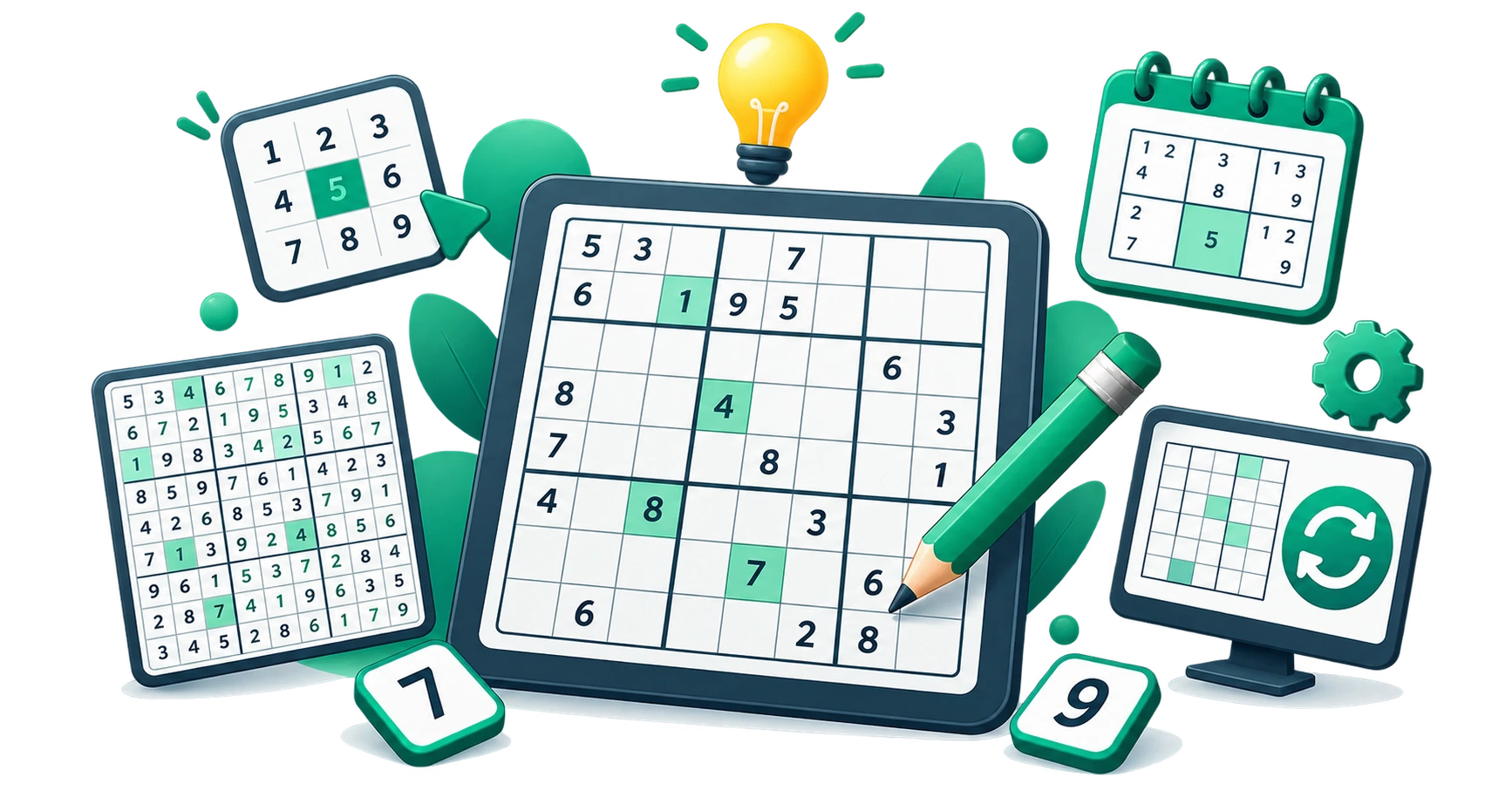
Sudoku is a logic puzzle played on a 9×9 grid divided into nine 3×3 boxes. The goal is to fill every empty cell with a digit from 1 to 9 so that each row, each column, and each 3×3 box contains all nine digits exactly once.
Despite its association with numbers, Sudoku is not a mathematics puzzle. No arithmetic is involved. The digits could be replaced with any nine distinct symbols (letters, colours, shapes) and the logic would be identical. Sudoku is purely about placement and elimination.
A brief history
The puzzle format now known as Sudoku was created by Howard Garns, an American architect and puzzle constructor, and first published in 1979 in Dell Pencil Puzzles & Word Games magazine under the name "Number Place."
In 1984, the Japanese puzzle company Nikoli introduced the puzzle to Japan under the name "Sūji wa dokushin ni kagiru" (数字は独身に限る), meaning "the digits must remain single." This was shortened to "Sudoku" (数独). Nikoli also made two important design changes: they required the given numbers to be arranged symmetrically on the grid, and they limited the number of given digits to no more than 32.
Sudoku remained primarily a Japanese phenomenon until 2004, when Wayne Gould, a retired judge from New Zealand, developed a computer programme to generate Sudoku puzzles and persuaded The Times (London) to publish them daily. The puzzle rapidly spread to newspapers worldwide and became one of the most popular logic puzzles in history.
The three rules of Sudoku
Sudoku has exactly three rules, and they are simple:
- Row rule: Every row of nine cells must contain the digits 1 through 9 with no repeats
- Column rule: Every column of nine cells must contain the digits 1 through 9 with no repeats
- Box rule: Every 3×3 box (there are nine of them) must contain the digits 1 through 9 with no repeats
A properly constructed Sudoku puzzle has exactly one solution.
Given digits and difficulty
A standard Sudoku puzzle starts with some cells already filled in. These are called "givens" or "clues." The number and placement of givens determines the puzzle's difficulty:
| Difficulty | Typical givens | Characteristics |
|---|---|---|
| Easy | 36–45 | Solvable with naked singles alone |
| Medium | 27–35 | Requires hidden singles and basic elimination |
| Hard | 22–26 | Requires pointing pairs, box-line reduction |
| Expert | 17–21 | May require X-wing, swordfish, or chains |
The mathematical minimum number of givens for a puzzle with a unique solution is 17. This was proven in 2012 by Gary McGuire and colleagues at University College Dublin through an exhaustive computational search.
Solving strategies: beginner to advanced
Strategy 1: Naked singles
Look at each empty cell and list which digits are already present in its row, column, and box. If only one digit is missing from the combined set, that digit must go in the cell. This is the most basic and most frequently used technique.
Strategy 2: Hidden singles
For each row, column, or box, check whether there is only one cell in which a particular digit can go. Even if that cell has multiple candidates, the fact that no other cell in the unit can hold that digit means it must go there.
For example, if the digit 7 can only appear in one cell within a particular 3×3 box (because all other cells in that box already see a 7 in their row or column), then that cell must contain 7.
Strategy 3: Pointing pairs and box-line reduction
If within a 3×3 box, a particular digit can only appear in one row (or one column), then that digit can be eliminated from the rest of that row (or column) outside the box. This is called a pointing pair (or pointing triple).
The reverse is also useful: if within a row, a digit's candidates are confined to a single box, that digit can be eliminated from the rest of that box.
Strategy 4: Naked pairs, triples, and quads
If two cells in the same unit (row, column, or box) have the same two candidates, those two digits can be removed from all other cells in that unit. The same logic extends to triples (three cells sharing three candidates) and quads.
Strategy 5: X-Wing
This advanced technique applies when a digit's candidates in two rows are confined to the same two columns. The digit can then be eliminated from those two columns in all other rows. The pattern forms an X shape on the grid, hence the name.
Strategy 6: Swordfish and beyond
Swordfish is the three-row extension of X-Wing. Even more advanced techniques include Jellyfish (four rows), XY-Wing, W-Wing, and various chain-based strategies. These are rarely needed in published puzzles but are important for competitive speed-solving.
How to generate custom Sudoku puzzles?
The CampaignMorph Sudoku Generator creates valid 9×9 Sudoku puzzles directly in your browser:
- Choose difficulty: select easy, medium, or hard, which controls how many givens are provided and which strategies are needed to solve
- Generate: the tool creates a puzzle with a guaranteed unique solution
- Customise the design: adjust grid colours, text colour, and background to match your needs
- Show or hide the solution: toggle the full solution grid for answer keys
- Export: download as PNG or SVG
The generation algorithm first creates a fully solved valid grid, then removes digits one at a time while verifying that the puzzle retains a unique solution at each step. This ensures every generated puzzle is solvable through logical deduction.
Use cases for custom Sudoku puzzles
Printable worksheets for classrooms
Teachers use Sudoku to develop logical reasoning skills. Easy puzzles work for primary school students learning systematic elimination. Harder puzzles challenge secondary students to engage in more advanced deductive thinking.
Puzzle books
Self-publishers create Sudoku collections for platforms like Amazon KDP. A typical book contains 100–200 puzzles across multiple difficulty levels, with solutions at the back; the Sudoku Generator exports at print-ready resolution.
Brain health and cognitive exercise
Sudoku is one of the most commonly recommended cognitive activities. While specific claims about preventing cognitive decline require careful interpretation of clinical research, the puzzle undeniably exercises working memory, pattern recognition, and logical deduction.
Daily puzzles and newsletters
Content creators and newsletter operators embed Sudoku puzzles as engagement content. A daily or weekly puzzle gives subscribers a reason to open the email and spend time with the brand.
Events and team activities
Sudoku works well as a competitive or collaborative activity at corporate events, school functions, and puzzle clubs. Print multiple puzzles at the same difficulty level for a timed solving challenge.
Tips for choosing the right difficulty
- For beginners and children: start with easy puzzles (36+ givens). The satisfaction of completing a puzzle builds confidence and interest.
- For daily practice, medium puzzles (27–35 givens) provide a satisfying 10–20-minute challenge.
- For experienced solvers: hard puzzles (22–26 givens) require techniques beyond basic singles and provide deeper logical engagement.
- For puzzle books, include a mix of difficulty levels. A common structure is 40% easy, 35% medium, 25% hard.
Frequently asked questions
1. What is Sudoku?
Sudoku is a logic puzzle where you fill a 9×9 grid with the digits 1–9 so that each row, column, and 3×3 box contains every digit exactly once.
2. Who invented Sudoku?
Howard Garns created the puzzle and first published it in 1979 in Dell Pencil Puzzles & Word Games as "Number Place." Nikoli introduced it to Japan in 1984 under the name Sudoku.
3. What is the minimum number of clues in a valid Sudoku?
This was proven computationally in 2012 by Gary McGuire and colleagues at University College Dublin. No valid 16-clue Sudoku puzzle with a unique solution exists.
4. Can every Sudoku be solved without guessing?
Yes, if it has a unique solution. A properly constructed Sudoku can always be solved through logical deduction. The strategies range from simple (naked singles) to advanced (X-Wing, chains), but guessing is never required.
5. Is Sudoku a maths puzzle?
No. Despite using digits 1–9, Sudoku involves no arithmetic. It is a pure logic and placement puzzle. The digits could be replaced with any nine distinct symbols.
6. Where can I generate Sudoku puzzles for free?
The CampaignMorph Sudoku Generator is free, runs in your browser, requires no sign-up, and exports puzzles as PNG or SVG.
Try the free Sudoku generator.
The CampaignMorph Sudoku Generator generates valid puzzles at three difficulty levels, with customisable design and instant export. No account needed, no data uploaded.
For more puzzle tools, explore the Nonogram Generator, Slitherlink Generator, Kakuro Generator, Crossword Generator, and Word Search Generator.
Sources
- Howard Garns, "Number Place," Dell Pencil Puzzles & Word Games, 1979
- Nikoli Co., Ltd. — introduced Sudoku to Japan in 1984 and established the symmetry and clue-count conventions
- Wayne Gould — developed Sudoku generation software and introduced the puzzle to The Times (London) in 2004
- McGuire, G., Tugemann, B., & Civario, G. (2012). "There is no 16-Clue Sudoku: Solving the Sudoku Minimum Number of Clues Problem." arXiv:1201.0749. University College Dublin
Share this article
Help other marketers, developers, and creators discover these insights.